








Why does your coffee taste better at a cafe than at home? The 7 details we don't notice
Time to read 10 min



Sign up for our newsletter and receive 10% off your first order.
Time to read 10 min
Table of Contents
You buy good coffee. You have a machine you love. You even replicate the recipe for your favorite latte.
And yet...
Sometimes there is that little something missing.
The coffee you order at your favorite coffee shop seems more aromatic, more balanced, rounder. The espresso has more body. The latte seems creamier. And even a simple black coffee seems to have more taste.
So, do coffee shops have a well-kept secret?
Not really.
The difference generally comes from an accumulation of small details: the freshness of the coffee, the grind, the water, the quantity used, the temperature, the maintenance of the equipment, and above all... consistency.
Good news: a large part of these details can be replicated at home.
Here are the 7 elements that can transform your daily coffee.
Everything starts with the bean.
Even the best machine in the world will have difficulty producing an exceptional cup with coffee that has lost a large part of its aromas.
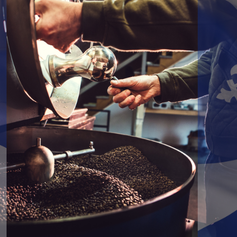
After roasting, coffee evolves gradually through contact with air, light, heat, and humidity. And once ground, the phenomenon accelerates considerably since much more surface area is exposed to the air.
This is why specialty coffee shops generally work with well-preserved beans that are ground as orders come in.
At home, what can we do?
A few very simple habits can already make a difference:
And above all: choose a coffee you really like.
There is no universally "better" profile. Some prefer mild and chocolatey coffees, others prefer more full-bodied roasts, or fruity and aromatic coffees.
The best starting point remains, therefore, a good bean... adapted to your palate.

This is probably one of the biggest differences between home brewing and a barista's preparation.
In a specialty coffee shop, the grinder isn't just set once and for all.
We adjust.
We taste.
We observe the flow.
Then we adjust again.
Why? Because the same setting doesn't necessarily work perfectly with all coffees. The type of bean, the roast, the age of the coffee, and even certain environmental variations can change the result in the cup.
In simple terms:
A grind that is too fine can slow down extraction and result in a coffee that is too bitter, dry, or intense.
A grind that is too coarse can produce an extraction that is too fast and a weaker, sour, or unbalanced cup.
A few notches on a grinder can make much more of a difference than one might think.
This is especially true for espresso.
If your usual coffee suddenly starts tasting different, don't change the beans immediately.
Try a slight adjustment to the grind first.
Your cup will give you plenty of clues.
→ Coffee flowing very quickly? Try a slightly finer grind.
→ Coffee flowing very slowly? Try a slightly coarser grind.
→ Very acidic coffee? Extraction might be insufficient.
→ Very bitter and drying coffee? You might be over-extracting.
To learn more, consult our Grind Guide to find the right grind for your brewing method.
A spoon.
A big spoon.
"About that much."
We've all done it.
And it's perfectly fine if you like the result.
But if your goal is to reproduce that truly successful cup every morning, precision becomes your best ally.
In a coffee shop, recipes are generally defined: a specific amount of coffee, a determined amount of water, and a targeted extraction time.
This consistency partly explains why your second cappuccino usually tastes like the first.
Imagine making lemonade without ever measuring the water or the lemon juice.
One day it would be perfect.
The next day, too concentrated.
Then completely diluted.
With coffee, it's exactly the same thing.
For filter coffee, a ratio of around 1:16, for example, is an excellent starting point: about 1 gram of coffee for 16 grams of water. It's not an absolute rule — your tastes come first — but it's a base that's easy to reproduce.
For espresso, the principle remains the same: we look for a recipe that is stable enough to then adjust only one parameter at a time.
You don't need to take out a calculator every morning.
A small kitchen scale is enough.
Once you've found your favorite recipe, write it down.
It's probably one of the least expensive ways to immediately improve the consistency of your home coffee.
We talk about coffee constantly.
Much less about water.
Yet, your cup is made up of it in the vast majority.
Its quality therefore directly influences the result.
Water that is heavily chlorinated, extremely hard, or conversely, too low in minerals can alter how coffee compounds are extracted and perceived on the palate.
You could prepare the exact same coffee with the exact same machine in two different cities… and get two different results.
Prepare your usual coffee for the first time using the water you use every day.
Then make the exact same recipe with filtered water.
Taste the two side by side.
The difference isn't always spectacular, but it can be surprising.
Water that is not hot enough may have difficulty extracting certain coffee compounds.
Conversely, excessive temperature combined with other parameters can contribute to a harsher or more bitter cup.
For many hot brewing methods, water around 90 to 96 °C is a commonly used starting range.
But again, coffee is not an immutable mathematical formula.
The goal is to find what works with your bean, your equipment, and especially your tastes.
Here is a detail that is easily forgotten.
You turn on your machine.
The indicator light says it's ready.
You prepare your espresso immediately.
In a professional environment, the equipment is often already hot and has been for a long time.
The group head, the portafilter, internal components, and even the cups have had time to reach a more stable temperature.
At home, some machines need a bit more time to truly stabilize, even if they seem ready to work.
When part of your equipment is cold, it absorbs some of the heat intended for extraction.
The result: your coffee may behave differently.
Depending on your machine, a few habits can help:
These are tiny gestures.
But coffee is precisely an accumulation of tiny details.
This is the least glamorous detail on this list.
And yet, it can have a huge impact.
Natural coffee oils gradually deposit on the components that come into contact with the beans or the brewed coffee.
Over time, these residues can oxidize and develop unpleasant tastes.
Add to that mineral deposits from the water, milk residues in milk systems, and particles accumulated in the grinder…
Your excellent new coffee might then pass through a whole path of old residues before arriving in your cup.
Not exactly the ideal recipe.
It also contributes directly to the quality of the coffee.
Depending on your equipment, consider in particular:
The best indicator remains your device's manual: every machine has its own needs.
If your coffee has gradually changed taste while you are still using the same beans and settings, a good cleaning might be the simplest solution.

This is probably the most important "secret" of all.
A barista prepares a huge amount of coffee.
Therefore, they develop automatic routines.
They use the same amount of coffee.
They observe the extraction.
They adjust their grinder.
They reproduce the same movements.
They know what they are looking to achieve.
At home, our preparation sometimes looks more like this:
A little coffee.
A little water.
While we prepare lunch.
We forget the coffee for a few seconds.
We come back.
We add milk.
We taste.
And tomorrow, we start again… differently.
There is absolutely nothing wrong with that.
Coffee remains, above all, a pleasure.
But if you have ever prepared an exceptional cup without ever being able to reproduce it, the reason might simply be that you no longer know exactly what you did.
The next time your coffee is particularly successful, note down:
Your favorite recipe could fit on a single line.
And suddenly, that famous “lucky success” coffee becomes much easier to replicate.
Not necessarily.
A better machine can certainly offer more stability, control, or possibilities.
But before replacing your equipment, start by optimizing what you already have.
Freshly ground coffee, an appropriate grind size, a consistent recipe, good water, and clean equipment can radically transform the result.
And above all, don't change five variables at once.
Change one.
Taste.
Then adjust.
That is exactly how you learn to understand your coffee.
To prepare better coffee at home, consider:
Individually, each of these details may seem minor.
Together, they can completely change your cup.
Reproducing the experience of a specialty coffee shop at home doesn't mean turning every brew into a science experiment.
Quite the opposite.
Understanding a few principles allows you to simplify your routine.
You will know why your espresso flows too quickly, why your drip coffee tastes more bitter than usual, or why this new bag requires a slight adjustment to the grinder.
And the more you understand what is happening in your cup, the easier it becomes to prepare coffee that truly matches your tastes.
At Ma Caféine, that is exactly what we love about coffee: there is always something to discover, to adjust… and above all, to enjoy.
Discover our selection of coffee beans roasted in Quebec, our grinders, and our accessories to create your own coffee experience at home.
Why isn’t my home coffee as good as it is at a coffee shop?
The difference doesn't necessarily come from your machine. The freshness of the beans, the grind, the coffee-to-water ratio, water quality, temperature, equipment maintenance, and consistency in preparation can all change the taste of your coffee.
Does a grinder really improve the taste of coffee?
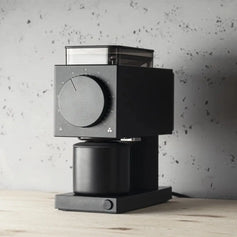
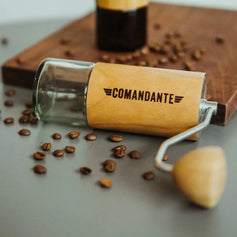
Yes. Grinding coffee right before brewing helps preserve more of its aromas and, most importantly, allows you to adapt the grind size to your brewing method. A good grinder also provides more consistency from one cup to the next.
Why is my coffee bitter?
A very bitter cup can have several causes: the grind is too fine, the extraction is too long, the temperature is incorrect, the amount of coffee is off, the roast is very dark, or the equipment is not clean. Try changing only one parameter at a time to identify the cause.
Why is my coffee acidic or sour?
An unpleasantly acidic coffee may be under-extracted. A grind that is too coarse, water that isn't hot enough, or an extraction time that is too short can contribute to this. Be careful, though: some coffees naturally feature a pleasant fruity acidity that is part of their flavor profile.
Should I use filtered water to make coffee?
Not necessarily, but water quality has a significant influence on taste. If your tap water is very chlorinated or highly mineralized, try the same recipe with filtered water and compare the two cups.
What is the simplest change I can make to improve my coffee?
Start with the grind and consistency. If possible, use coffee beans ground just before brewing, and measure your coffee and water. These two habits alone can help you achieve much more consistent results.

Gaëlle, Ma Caféine shop manager
Passionate about coffee, tea, and quality products, Gaëlle shares her tips, discoveries, and inspirations on the Ma Caféine blog to help you savor every cup.
Your cart is currently empty.
Start Shopping


